

+918048036466

Currently it only shows your basic business info. Start adding relevant business details such as description, images and products or services to gain your customers attention by using Boost 360 android app / iOS App / web portal.

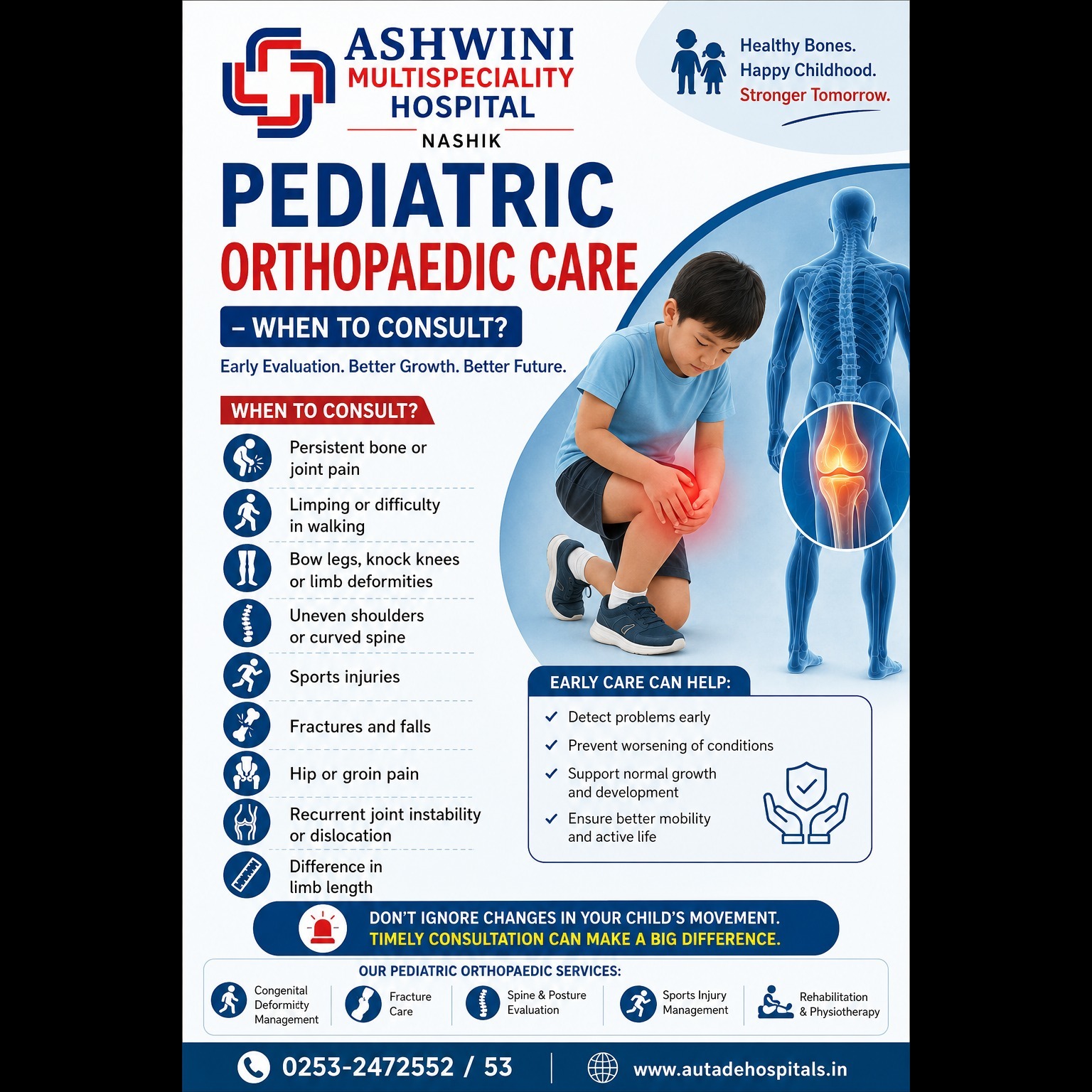
Healthy bones, joints and muscles are essential for a child’s growth, mobility and overall development. Children are not simply “small adults”—their bones and growth plates are still developing, so some orthopaedic problems require age-specific assessment and treatment. At Ashwini Multispeciality Hospital, Nashik, timely orthopaedic evaluation can help identify problems early and guide parents toward appropriate treatment. What is Pediatric Orthopaedic Care? Pediatric orthopaedics focuses on conditions affecting the bones, joints, muscles, ligaments and spine of infants, children and adolescents. Some problems may be temporary and improve with growth, while others can become more difficult to correct if diagnosis is delayed. Early evaluation is particularly important when a child has persistent pain, abnormal walking, deformity, repeated injuries or difficulty participating in normal activities. When Should Parents Consult an Orthopaedic Specialist? 1. Persistent Bone or Joint Pain Occasional aches may occur after physical activity, but persistent, recurrent or worsening pain should not be ignored. Consult an orthopaedic specialist if your child has: Repeated knee, ankle, hip, shoulder or elbow pain Pain that limits playing or walking Pain associated with swelling Pain that keeps returning despite rest Sports-related conditions in children and teenagers can involve the knee, ankle, elbow and other joints and may require proper assessment. 2. Difficulty Walking or Abnormal Gait Parents should seek evaluation if a child: Walks with a limp Frequently trips or falls Walks differently on one side Has difficulty running or climbing stairs Develops a new walking abnormality A change in walking pattern can sometimes be related to the hip, knee, ankle, foot, muscle or neurological system. 3. Bow Legs, Knock Knees or Other Limb Deformities Some variations in leg alignment are normal during childhood development. However, significant, asymmetric or persistent deformity may need assessment. Examples include: Bow legs Knock knees Unequal leg length Foot deformities In-toeing or out-toeing Progressive limb deformity Early assessment helps determine whether the condition is part of normal growth or requires observation, physiotherapy, bracing or another treatment. 4. Uneven Shoulders or Curved Spine Parents may notice: Uneven shoulders Uneven waistline One shoulder blade appearing more prominent A visible sideways curve of the spine Changes in posture These can be signs of scoliosis. Scoliosis commonly becomes noticeable during childhood or adolescence, particularly around the growth-spurt years. Some curves only require monitoring, while more significant curves may require bracing or surgery. 5. Sports Injuries Children and teenagers involved in football, cricket, athletics, basketball and other sports may experience: Ligament injuries Meniscus injuries Fractures Muscle or tendon injuries Recurrent joint instability Pain after an injury should not simply be ignored, particularly if there is swelling, instability or difficulty returning to normal activity. Young athletes can also develop conditions that are less common in adults, so assessment by a clinician familiar with growing bones can be valuable. 6. Fractures and Falls Children are active and frequently sustain falls. A fracture may present with: Significant pain Swelling or bruising Difficulty moving the limb Loss of function Visible deformity Certain childhood fractures require prompt treatment because they can involve the growth plate or affect future bone development. 7. Hip or Groin Pain Hip problems in children may sometimes present as knee or thigh pain rather than obvious hip pain. A child with persistent limp, hip pain, restricted movement or unexplained knee pain should be assessed. Early diagnosis can be important because some childhood hip conditions require timely treatment to protect normal development. 8. Recurrent Joint Dislocation or Instability If a child's shoulder, kneecap, elbow or another joint repeatedly “slips out, ” it should be evaluated. Repeated instability can affect confidence, sports participation and joint function. The underlying cause should be identified before deciding on treatment. 9. Difference in Limb Length If one leg or arm appears shorter than the other, or the child develops an uneven walking pattern, an orthopaedic assessment may be recommended. Depending on the cause and amount of difference, treatment may range from observation and monitoring to corrective procedures. When Is Immediate Medical Attention Needed? Some injuries require urgent assessment rather than waiting for a routine appointment. Seek emergency medical attention if your child has: Severe pain after an injury A visibly crooked or deformed limb Severe swelling An open wound associated with an injury A hand or foot that becomes unusually pale, cool or numb Inability to move the affected limb or fingers/toes These symptoms can indicate a serious fracture or possible injury to nerves or blood vessels. What Happens During a Pediatric Orthopaedic Consultation? The doctor generally begins with a detailed history and physical examination. Depending on the child's symptoms, additional investigations such as X-ray or MRI may be recommended. Treatment depends on the child's age, growth stage, diagnosis, severity and functional limitations. Many childhood orthopaedic problems can be managed without surgery; treatment may include observation, activity modification, physiotherapy, casting, bracing or other non-surgical approaches. Surgery is considered only when clinically appropriate. Why Early Evaluation Matters A child's musculoskeletal system is continuously developing. Identifying an orthopaedic problem early can help: Detect developmental abnormalities Monitor growth and limb alignment Prevent worsening of certain deformities Treat injuries appropriately Protect sports participation and mobility Plan rehabilitation when required Reduce the risk of long-term functional problems However, not every childhood orthopaedic concern requires surgery. The right treatment is based on an individual assessment. Pediatric Orthopaedic Care at Ashwini Multispeciality Hospital, Nashik At Ashwini Multispeciality Hospital, Nashik, children with orthopaedic concerns can receive evaluation and treatment for problems involving the bones, joints, limbs, spine, sports injuries and fractures. If your child has persistent pain, abnormal walking, limb deformity, repeated falls, sports injury or difficulty with normal movement, consulting an orthopaedic specialist can help determine the cause and appropriate next step. Don't Ignore Changes in Your Child's Movement Pain, limping, deformity or difficulty walking should not always be considered a normal part of growing up. Early evaluation can provide reassurance when the condition is normal—and timely treatment when intervention is needed. Ashwini Multispeciality Hospital, Nashik Trusted Care. Advanced Treatment. Better Recovery. 📞 0253-2472552 / 53 🌐 www.autadehospitals.in This article is for general educational information and does not replace an examination by a qualified medical professional.


